
Speed and passion, quality first
To accelerate innovation and safeguard qualityOur end-to-end service is a highly collaborative and seamless' highway '
Date:2019-05-14
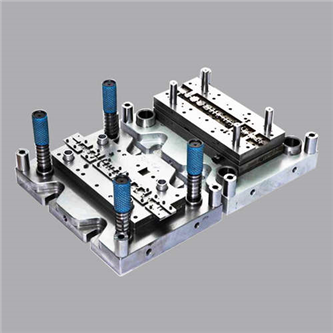
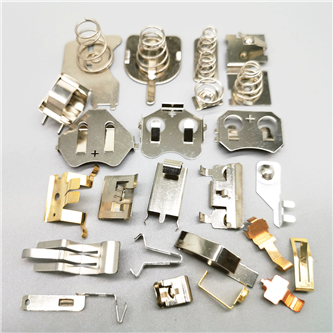
The production process of stamping dies is the entire process of processing raw materials into stamping die parts required by design drawings through casting, forging, cutting, and special processing, and then assembling the stamping die parts into molds according to the technical requirements of design and process specifications. Stamping dies are essential molds in stamping production, which can be basically divided into three types: simple dies, continuous dies, and composite dies.

Simple die
A simple punching die is a punching die that completes only one process in one stroke of a punch press. It is a simple die used for cutting or punching. When the assembly diagram of the simple die is working, the strip material is fed along the concave die between two guide plates 9 until it touches the positioning pin 10. When the punch is pressed downwards, the punched parts (or waste) enter the cavity of the punch, while the strip material clamps the punch and moves back upwards with the punch. When the strip touches the discharge plate 8 (fixed on the concave mold), it is pushed down, so that the strip continues to be fed between the guide plates. Repeat the above action and rush down the second component.
Continuous punching die
A mold that completes multiple stamping processes simultaneously on different parts of the mold during one stroke of a punch press is called a continuous mold. When working, align the Ding pin 2 with the pre punched positioning hole, move the upper mold downwards, use the convex mold 1 for material feeding, and use the convex mold 4 for punching. When the upper mold returns, the discharge plate 6 pushes down the waste material from the convex mold. At this point, feed the billet 7 forward and perform the second punching. This cycle is repeated, with each feeding distance controlled by the stopper pin.
Composite punching die
A mold that completes multiple stamping processes simultaneously on the same part of the mold in one stroke is called a composite mold. The biggest feature of composite molds is the presence of a convex concave mold 1 in the mold. The outer circle of the convex concave die is the cutting edge of the feeding convex die, and the inner hole becomes the deep drawing concave die. When the slider moves downwards with the convex and concave molds, the strip material first falls into the convex and concave molds 1 and 4. The falling part is held by the deep drawing punch 2 in the lower mold, and when the slider continues to move downwards, the punch moves downwards for deep drawing. The ejector 5 and unloader 3 push the deep drawn part 9 out of the mold during the return of the slider. Composite molds are suitable for stamping parts with high output and precision.

The above is aboutThe important role of stamping dies in stamping production: http://www.bosiwj.com/mp-14.html
The key points of knowledge, I hope it can help everyone increase their understanding of the role of stamping dies. If you need customized molds, you can contact us







 Language
 Your location:
.jpg)
 Official account
 0769-82928019
 E-mail